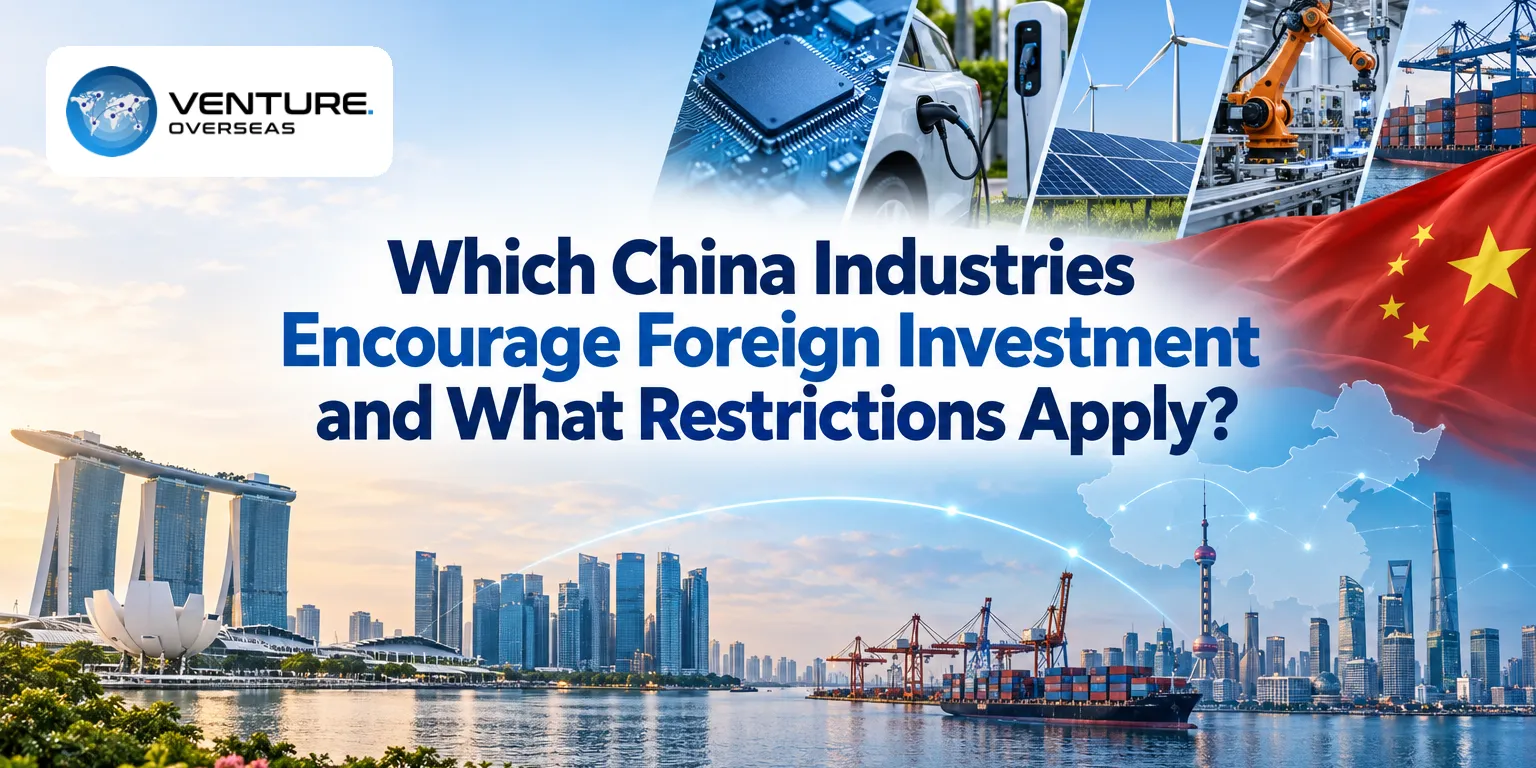
China's 2025 catalogue encourages investment in priority industries. Its shortest-ever negative list was approved in late 2024, opening manufacturing and widening access to its broadest level in decades. The catch is that a handful of restricted and prohibited sectors still exist, and without a current map they are easy to stumble into.
Since the Foreign Investment Law took effect on 1 January 2020, China has managed inbound capital through a simple principle. Sectors not on the negative list are open by default, while a separate encouraged catalogue rewards priority investments with tax and land incentives. The 2025 edition of that catalogue, effective from 1 February 2026, expanded coverage in manufacturing and modern services.
For Singapore companies, the stakes are concrete. China remains one of Singapore's largest trading partners, and the China-Singapore Free Trade Agreement (CSFTA) adds tariff and market-access advantages on top of national treatment. Knowing where your sector sits also unlocks support from home, including tax deductions and grants that help fund the expansion itself.
In this blog, we discuss how China classifies foreign investment. We explain what the encouraged industries catalogue covers. We also examine remaining restrictions. Finally, we look at home-market incentives for Singapore SMEs. Let's start with the rules that govern access.
Table of Contents
How Does China Decide Which Industries Are Open to Foreign Investment?
Access rests on two official documents under the Foreign Investment Law. The law took effect on 1 January 2020. The negative list identifies restricted sectors. The encouraged catalogue identifies priority investments. Everything not on the negative list is open to you by default, a principle known as pre-establishment national treatment. In practice, we help clients read both documents together, because a single activity can be open nationally yet encouraged only in particular provinces.
The system has three moving parts worth knowing.
1. The Foreign Investment Law
This law, in force since 1 January 2020, replaced three decades-old statutes governing equity and cooperative ventures. It treats foreign investors the same as domestic ones before market entry, and it protects the transfer of profits, capital contributions and IP proceeds. Disputes can now be settled under clearer, unified rules.
2. The negative list
The current national list, effective from 1 November 2024, contains 29 items, down from 31 in the 2021 version. The 2021 free trade zone list contains 27 items. Locating inside a zone can open sectors that remain capped elsewhere. Notably, all manufacturing restrictions were removed in the 2024 revision.
3. The encouraged catalogue
This positive list, jointly updated by China's top planning and commerce ministries, names the sectors and regions where foreign capital is most wanted. Qualifying projects enjoy tangible perks, which we cover in the next section.
What Is China's Encouraged Industries Catalogue for Foreign Investment?
It is China's positive list of priority sectors, jointly published by the National Development and Reform Commission (NDRC) and the Ministry of Commerce (MOFCOM). The 2025 edition took effect on 1 February 2026 and added entries across manufacturing, services and regional lists. For Singapore SMEs, the catalogue matters because it doubles as an incentives map for anyone weighing market entry.
Catalogue inclusion does not guarantee every benefit. Eligibility depends on the project, location and applicable policy. Qualifying projects may receive the following:
Benefits for encouraged-catalogue projects include:
- Customs-duty exemptions for eligible self-use imported equipment, subject to exclusions
- Preferential land-use terms for qualifying land-efficient industrial projects
- A reduced 15% corporate income tax rate for qualifying enterprises in western China, under the western development policy through 2030
- Foreign-exchange facilitation or policy-bank financing where separately available and approved
1. Advanced manufacturing
The catalogue leans into semiconductors, high-end machine tools, aviation components, rail equipment and new materials. These entries signal where supply-chain localisation is welcomed rather than merely tolerated.
2. Green energy and the circular economy
Renewable generation, energy storage, hydrogen and EV battery production all carry strong encouragement, as do recycling and resource-recovery projects. Sustainability-linked investments are among the clearest wins in the list.
3. Health and modern services
Elder care, rehabilitation facilities, vocational training, logistics and R&D centres feature prominently. This reflects China's demographic shift and its ambition to upgrade the services economy.
4. Regional encouragement
Provinces such as Sichuan, Shaanxi, Hunan and Jilin have regional entries. Location can affect eligibility, but the project must meet the relevant conditions.
China's Foreign Investment Categories at a Glance
| Category | What it means for you | Typical examples |
|---|---|---|
| Encouraged | Fully open, with tax and land incentives for qualifying projects | High-end manufacturing, green energy, R&D, elder care |
| Permitted | Fully open, no special incentives apply | Most consumer goods and business services |
| Restricted | Open, but capped or subject to joint-venture conditions | Value-added telecom, airlines, film production |
| Prohibited | Closed to all foreign investors | News media, broadcasting, certain mineral extraction |
What Foreign Investment Restrictions Still Apply Under the Negative List?
The 2024 national negative list, in force since 1 November 2024, keeps 29 restricted or prohibited items, and the free trade zone version runs slightly shorter. That is a dramatic narrowing from the 48 items of 2018, but the remaining items still catch unwary investors.
1. Restricted sectors and ownership caps
Value-added telecom is generally capped at 50% foreign equity, though pilots announced in 2024 allow full ownership for certain services in cities including Beijing, Shanghai and Shenzhen. Basic telecom, airlines and domestic shipping require Chinese control; the Chinese-control requirement for urban gas and heat pipelines was removed in 2019. Film production and cinema operations remain joint-venture territory.
2. Prohibited sectors
News organisations, broadcasting and radio remain fully closed, as do certain mineral extraction and state-secret-sensitive activities. No structure gets around these walls, so screen your intended business scope early.
3. National security review
Since the 2021 review measures, transactions that hand foreign investors control in military-related or strategically important sectors require a pre-closing review. The scope includes defence-adjacent supply chains and, in defined cases, acquisitions of listed companies.
4. Registration and reporting duties
Foreign-invested enterprises register with the market regulation authorities and submit annual investment information to the competent commercial department through the National Enterprise Credit Information Publicity System. These are routine obligations, but lapses carry penalties.
Which Sectors Should Investors Watch for Further Opening?
Watch the pilots, because they preview the next negative-list revisions. Announcements since late 2024 point clearly towards services, healthcare and digital infrastructure, and every list revision since 2018 has moved in one direction only.
The current watch-list includes:
- Wholly foreign-owned hospitals, permitted in pilot cities including Beijing, Shanghai, Tianjin and Shenzhen from late 2024
- Full foreign ownership of certain value-added telecom services, piloted in Beijing, Shanghai, Hainan and Shenzhen
- Eased cross-border data transfer rules introduced in 2024, simplifying compliance for digital businesses
- Widening biotechnology and clinical-research pilot zones in designated parks
Pilots are geographically limited and conditional, so treat them as a signal rather than a guarantee. Even so, they tell you where regulators are building comfort for the next round of liberalisation.
How China's Negative List Has Shrunk Since 2018
| List version | National list (items) | FTZ list (items) |
|---|---|---|
| 2018 | 48 | 45 |
| 2019 | 40 | 37 |
| 2020 | 33 | 30 |
| 2021 | 31 | 27 |
| 2024 (from 1 Nov) | 29 | 27 |
How Can Singapore Companies Pair China Access with Home Incentives?
China and Singapore offer separate incentives, each with its own eligibility conditions. Check how grant support affects tax deductions before budgeting for market entry.
Start with the tax treaty. Under the Singapore-China Double Taxation Agreement, dividend withholding tax falls to 5% where your Singapore company holds at least 25% of the Chinese entity, so structure your shareholding deliberately. Plan early how you will repatriate profits from China, because timing and documentation affect the effective tax cost on the way home.
At home, the Inland Revenue Authority of Singapore (IRAS) administers the Double Tax Deduction for Internationalisation (DTDi) scheme. It allows a 200% tax deduction on qualifying expenses such as overseas market development trips, trade fairs and advertising. The automatic cap is S$150,000 per Year of Assessment through YA 2026, rising to S$400,000 from YA 2027 under the Budget 2026 enhancements.
Enterprise Singapore (EnterpriseSG) offers the EDGE grant for eligible activities, including overseas expansion. For SMEs, support for eligible internationalisation activities can reach 70% of costs. An overall S$100,000 annual company cap applies. EDGE replaced new MRA applications from 30 September 2026; earlier MRA applications and projects continue under their terms.
Singapore Support Schemes for China Market Entry
| Scheme | Administered by | What it offers |
|---|---|---|
| Double Tax Deduction for Internationalisation (DTDi) | IRAS with EnterpriseSG | 200% deduction on qualifying expenses; S$150,000 cap per YA through YA 2026, S$400,000 from YA 2027 |
| Market Readiness Assistance (MRA), closed 29 September 2026 | Enterprise Singapore | Up to 70% support for qualifying SME costs; S$50,000 cap per new market for overseas business development |
| China-Singapore Free Trade Agreement (CSFTA) | Both governments | Tariff and market-access advantages for Singapore-based investors |
How Do You Confirm Where Your Sector Sits Before Investing?
Start with the two official lists, then verify your specific activity at provincial level before committing funds. Six steps keep the process honest.
- Download the current national and free trade zone negative lists, and search for your activity, noting that translations vary between versions
- Check the encouraged catalogue for your sub-sector, including provincial supplements that add eligible activities
- Confirm implementation details with the local commerce bureau or a licensed corporate services partner, especially in regulated sectors
- Choose your structure — a wholly foreign-owned enterprise, a joint venture or a representative office — and settle who will act as your statutory officer; choosing a legal representative in China is among the most consequential early calls
- Budget for people, because hiring foreign employees in China triggers work-permit and social-insurance duties
- Build remittance, tax filings and annual reporting into your timeline from day one
Before committing capital, many Singapore SMEs speak to the Venture Overseas team to pressure-test their market read against the current lists.
China's foreign-investment access is wider than at any point in the past decade. The national negative list has 29 items. It no longer restricts manufacturing entry. The encouraged industries catalogue identifies priority sectors that may qualify for incentives. For Singapore SMEs, the winning move is to match your sector and target province to the right list before spending a dollar.
Venture Overseas helps Singapore companies read China's investment rules correctly, structure their entity, and stack home-market incentives such as DTDi and eligible EDGE support on top. Are you weighing a China entry in the year ahead? We would be glad to help you plan it with confidence. Start a conversation with our team today.
Plan Your China Market Entry with Confidence
Tell us your industry and target region, and we will help you map access rules, incentives and the right entry structure.
Frequently Asked Questions
The encouraged catalogue is a positive list of sectors where Beijing rewards foreign investment with incentives such as import-duty exemptions. The negative list is the opposite: it names only the restricted and prohibited sectors, and anything outside it is open by default.
Yes. A wholly foreign-owned enterprise can invest in sectors outside the foreign investment negative list, subject to the separate Negative List for Market Access and applicable licensing requirements, and the 2024 revision removed the last manufacturing restrictions, so factory-based investors no longer need a Chinese partner.
News organisations, broadcasting and radio remain closed, along with certain mineral extraction and activities touching state secrets. These appear on the prohibited portion of the national negative list.
Qualifying projects can claim customs-duty exemptions on self-use imported equipment, preferential land-use terms, and in western regions a reduced 15% corporate income tax rate under the western development policy.
The CSFTA provides tariff and market-access benefits, and the Singapore-China tax treaty cuts dividend withholding tax to 5% where your Singapore company holds at least 25% of the Chinese entity. At home, IRAS's DTDi scheme and EnterpriseSG's EDGE grant can support eligible expansion activities.

Venture Overseas
Global business expansion guides
Venture Overseas is a Singapore-headquartered company that helps entrepreneurs and businesses expand overseas with market information, country guides and information on grants and funding.