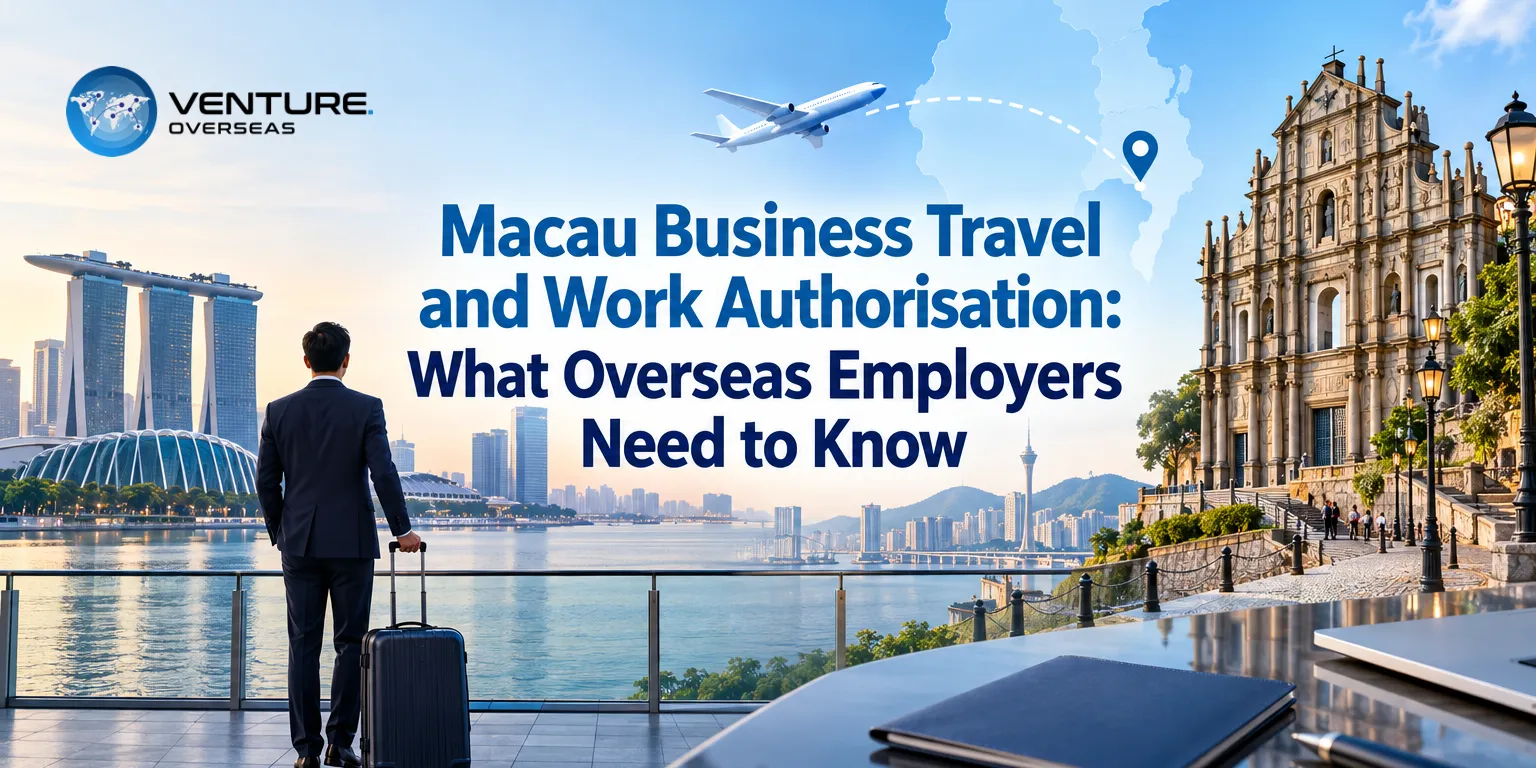
Planning to send staff to Macau? Macau work permit requirements depend on whether your team is making short business trips or taking up local employment. Getting that classification right before anyone boards a flight saves your company time, money and paperwork.
Macau rewards that homework. The special administrative region sits inside the Greater Bay Area, about an hour from Hong Kong by road bridge. It is a free port with a simple tax regime and a headline profits tax capped at 12 per cent. Its economy leans on hospitality, events, retail and trade, with English and Mandarin widely used in business.
For employers, the catch is that Macau controls its own immigration. A mainland Chinese work visa does not authorise anyone to work in Macau. Treating a posting as ordinary tourism is a common and costly mistake.
What follows is practical rather than legalistic. In this blog, Venture Overseas explains Macau work authorisation for foreign employees. It covers the rules for business travel, the obligations after approval, and the Singapore schemes that can fund your move.
Table of Contents
What are Macau work permit requirements for foreign employees?
According to DSAL, Macau's work permit requirements involve a two-stage process for foreign employees. Your company first needs permission to hire a non-resident worker, and your employee then needs permission to stay. Both stages trace back to Macau's Law 21/2009 on hiring non-resident workers.
The Labour Affairs Bureau (DSAL) is the first stop. DSAL checks your application against the approved quota of non-resident posts for your sector. Macau's government sets these quotas and reviews them regularly, so availability shifts over time. Certain occupations are also reserved for local residents.
The process typically runs in five steps, summarised in the table that follows the business-travel comparison below. Timelines vary by sector and quota, so build lead time into your hiring plan.
One boundary note: these routes cover Macau only. Mainland China runs a separate system, so if you are hiring foreign employees in China, plan a different application.
1. The hiring permission comes first
Your DSAL application normally needs a draft employment contract, proof of your Macau business registration, and a reasoned case for the hire. DSAL then confirms the quota position and whether the role is open to non-residents.
2. The blue card is your employee's proof of status
After approval, the employee completes a standard health screening and collects the non-resident worker identity card. Locally it is called the blue card. It doubles as your employee's identification while working in Macau.
3. Posting a Singapore employee to Macau
Secondments follow the same permit logic. Your group applies through DSAL for posted staff, and the employee still needs a valid permission to stay. A Singapore payroll does not exempt anyone from Macau work authorisation.
Do your visiting staff need a Macau business travel visa?
There is no dedicated Macau business travel visa. Your team enters under Macau's ordinary visitor rules, which cover meetings, negotiations, trade fairs and market research. Depending on nationality, travellers may be visa-exempt, may apply for an entry permit or visa on arrival, or may need a visa in advance. Visitor entry alone does not authorise local employment; whether a service is exempt depends on its circumstances, not where the salary is paid.
Macau keeps its own visa policy, separate from Hong Kong and from mainland China. Macau also hosts a large calendar of trade fairs and industry events, which keeps business travel frequent. The comparison below shows which route each situation calls for.
1. Who can enter without a visa
Holders of many passports, including Singapore passports, enter Macau visa-free for short stays. Typical allowances range from 30 to 90 days, with some nationalities permitted longer. Confirm each traveller's allowance with Macau's Public Security Police Force (PSP) before booking.
2. What business visitors may do
Client meetings, site inspections, contract negotiations and market research are normal visitor activities. The safe rule is that visitors may plan and promote your business, but they may not be employed in Macau.
3. When a trip crosses into work
Installation, servicing, training delivery and hands-on shifts can constitute work. Under Article 4 of Administrative Regulation No. 17/2004, certain specific or occasional services, including qualifying training or maintenance, may be exempt, subject to its conditions and time limit. Selling or operating goods on site at a trade fair can also constitute work. Obtain work authorisation unless an exemption applies; a visitor stamp alone does not authorise it.
Which Macau authorisation applies to business trips and hires?
| Purpose of the trip | Authorisation needed | Employer watch-outs |
|---|---|---|
| Client meetings, negotiations, market research | Visitor entry (visa-free or visit visa by nationality) | Keep proof of the trip's business purpose |
| Trade fairs, exhibitions and conferences | Visitor entry, with event invitations or exhibitor documents | Selling or installing on site may count as work |
| Short installation, training or servicing | Work authorisation via DSAL unless a specific exemption applies | A business-trip label does not permit productive work |
| Local hire or posting into Macau | Hiring permission plus blue card | Apply before travel and renew on schedule |
What employer obligations come with a Macau hire?
Approval is only the start. Macau's labour law, payroll withholding and end-of-assignment rules all attach to the hire, and the employer carries them.
1. Contract, hours and pay
Macau's Labour Relations Law (Law 7/2008) sets the floor for terms. Standard hours cap at eight per day and 48 per week in most cases, with premiums for overtime. Statutory annual leave and public holidays also apply.
2. Taxes and registrations
Your employee's Macau earnings attract professional tax, handled through employer withholding. Register with Macau's Financial Services Bureau and confirm current rates, which have been capped at 12 per cent in recent years.
3. End-of-assignment duties
As a rule, the employer bears the return journey cost when the contract ends. Notify DSAL of terminations or changes, surrender permits, and keep work strictly within the authorised scope.
Macau work visa process for foreign employees: five steps
| Step | What happens | Who leads |
|---|---|---|
| 1. Confirm quota eligibility | Check reserved occupations and current sector quota availability | Employer |
| 2. File the hiring permission | Submit contract, registration documents and justification to DSAL | Employer |
| 3. Secure permission to stay | Immigration aligns the worker's stay with the approved contract | Employer or employee |
| 4. Health screening and blue card | Complete the medical check and collect the worker identity card | Employee |
| 5. Renew or wrap up | Renew before expiry, or surrender permits and arrange return travel | Employer |
Which Singapore schemes can fund your Macau expansion?
Several Singapore schemes fit a Macau move. Enterprise Singapore offers market-expansion grants, while the Inland Revenue Authority of Singapore (IRAS) allows double deductions on qualifying costs. The main options appear in the table below.
Before it closed, the Market Readiness Assistance (MRA) grant was the usual starting point. Updated on 1 April 2026, it supported three pillars for each new market:
- overseas market promotion, capped at S$20,000
- overseas business development, capped at S$50,000
- overseas market set-up, capped at S$30,000
If you post a business development manager to Macau, the Overseas Marketing Presence (OMP) option is now closed, as the support table below notes. It supported basic salary and office rental for six to twelve months. Support for SMEs ran at up to 70 per cent for Singapore BD staff and 50 per cent for foreign staff. The employee had to remain stationed in-market for the whole project.
On the tax side, the Double Tax Deduction for Internationalisation (DTDi) scheme doubles the deduction on qualifying market-expansion expenses. These include overseas market development trips and approved trade fairs, up to the annual cap. The scheme covers qualifying expenses incurred up to 31 December 2030.
From Year of Assessment (YA) 2027, the automatic cap rises from S$150,000 to S$400,000 per YA, and the qualifying list expands to include:
- investment feasibility and due-diligence studies
- master licensing and franchising
- market surveys and feasibility studies
- overseas business development
- corporate brochures for overseas distribution
DTDi can also cover qualifying salary costs of Singapore Citizens and Permanent Residents posted overseas, with EnterpriseSG approval. The combined cap for such salary expenses and certain investment expenses is S$1 million per approved entity per YA. Since 1 January 2026, the employee-overseas-posting activity sits under the overseas trade office category.
One caution: no grant replaces immigration compliance. Enterprise Singapore says to submit an EDGE application before starting project work or making payments or deposits to suppliers, vendors or third parties. EDGE is Enterprise Singapore's grant for eligible business activities, and applications are submitted through the Business Grants Portal; the business development employee need not already be hired. Secure Macau work authorisation before the employee works there unless a specific exemption applies.
Singapore support for a Macau market entry in 2026
| Support | What it covers | Current parameters |
|---|---|---|
| Market Readiness Assistance (MRA) grant | Market promotion, business development and set-up per new market | Caps of S$20,000, S$50,000 and S$30,000 per new market; closed 29 September 2026 |
| Overseas Marketing Presence (OMP; closed) | Posted BD manager's basic salary and office rental, 6 to 12 months | SMEs: up to 70% for Singapore staff, 50% for foreign staff |
| Double Tax Deduction for Internationalisation (DTDi) | Double deduction on qualifying market-expansion expenses | S$150,000 per YA to YA 2026; S$400,000 from YA 2027 |
What challenges should you plan around in Macau?
Six frictions recur for employers. Plan around quotas, reserved occupations, renewals, local costs, administrative language and specialist talent, and most surprises disappear.
- Quota availability moves with government policy, so approvals are never guaranteed
- Some occupations are reserved for Macau residents, which can block frontline hires
- The employment contract term must not exceed the employment permit period, so track both expiry dates and plan renewals ahead.
- Office and housing costs in central Macau run higher than many budgets expect
- Official paperwork often appears in Chinese and Portuguese, so translations add time
- Talent pools run deep in hospitality and events, while niche technical roles stay thin
Cross-border reach brings one more check. If your plans include a mainland-facing website or online store, confirm whether you need an ICP filing or licence in China first.
A second opinion helps before those frictions reach the border. Venture Overseas reviews market-entry briefs and overseas hiring plans, and you can begin through its contact page.
Getting Macau right is mostly a matter of sequencing. Classify every trip before anyone flies, secure DSAL permission before any hire, and match each posting to the right authorisation. Renewals then become routine.
The same discipline applies to funding. EDGE support and DTDi deductions can help trim the cost of your first Macau year when you meet their conditions.
Venture Overseas helps Singapore SMEs plan exactly this. Its advisors map hiring routes, flag compliance steps and connect companies with in-market partners across Asia. Share your expansion brief, and the team will help you sequence a confident Macau entry.
Plan your first Macau hire with confidence
Tell the Venture Overseas team about your market-entry or hiring plans, and get a practical, current route map for Macau.
Frequently Asked Questions
No. Singapore passport holders enter Macau visa-free for short stays, which covers meetings, trade fairs and market research. Confirm the current permitted length of stay before booking.
Productive work generally requires work authorisation, but certain specific or occasional services, including qualifying training or maintenance, can be exempt under Administrative Regulation No. 17/2004, subject to its conditions and time limit.
Timelines vary by sector quota and role. Allow several weeks to a few months, and file before your employee travels.
Generally no. A DSAL hiring permission attaches to a Macau-registered employer, so most overseas companies first set up a local entity or branch.
Work must stop until a renewal is granted. Apply before expiry, notify DSAL of any changes, and never leave an employee in a lapsed stay.

Venture Overseas
Global business expansion guides
Venture Overseas is a Singapore-headquartered company that helps entrepreneurs and businesses expand overseas with market information, country guides and information on grants and funding.