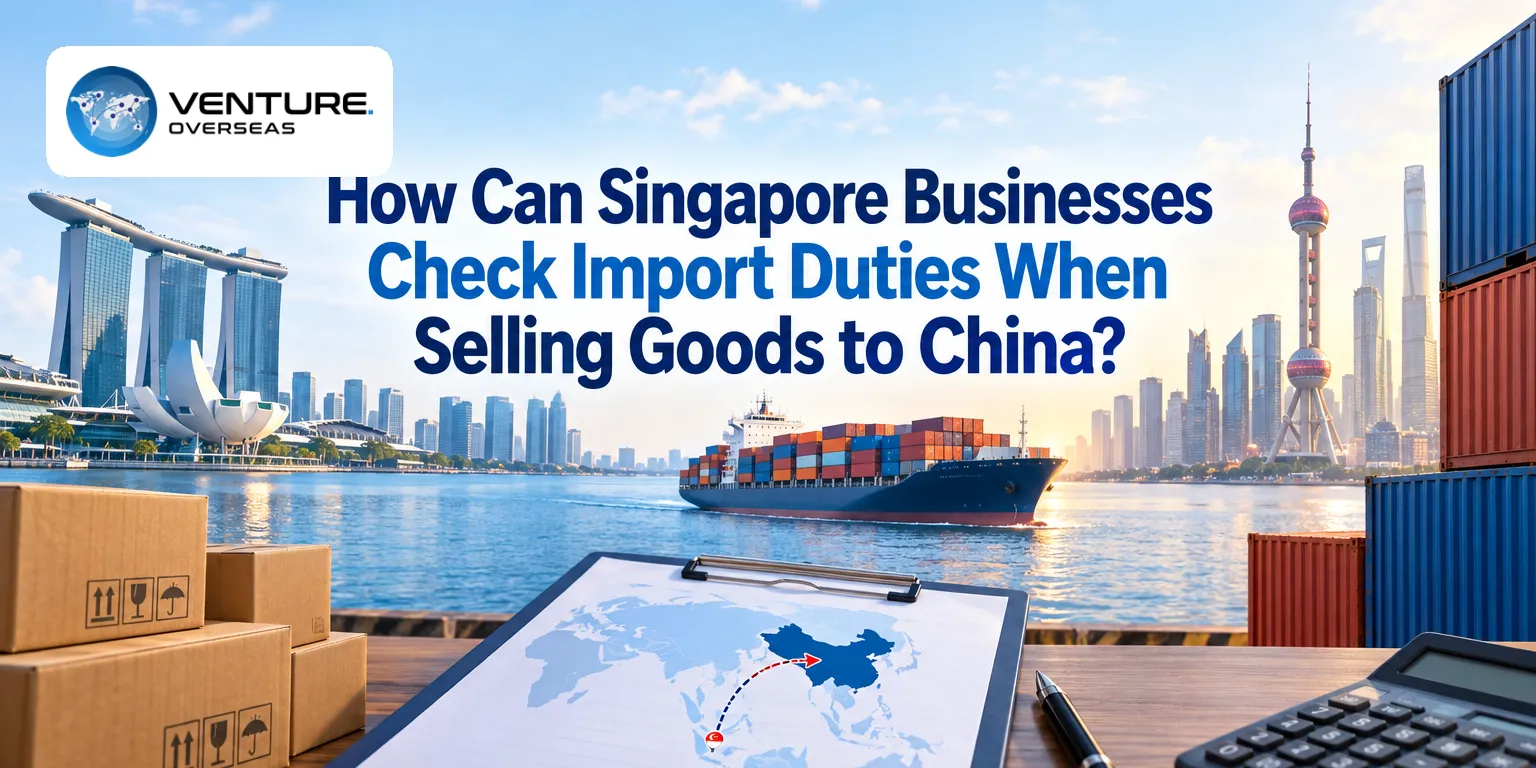
Before you can quote a sensible price to a Chinese buyer, you need one number: the tariff China will collect when your goods clear the border. Learning to check China import duty rates early keeps your landed costs honest and protects your margins from day one.
The stakes are high. Mainland China was Singapore’s second-largest merchandise trading partner in 2025, behind Taiwan, and demand for Singapore-made food, electronics, precision parts and consumer brands keeps growing. At the same time, China's tariff schedule is detailed and changes with each year's adjustments.
The good news is that Singapore businesses enjoy unusually strong tools here. Three trade agreements cover China-bound shipments, and a free official tariff finder puts the rates a few clicks away. Most exporters simply do not know where to start.
In this blog, we discuss how China import duties work and where to find the exact rate for your product. We also cover preferential certificates and Singapore grants and tax schemes that can offset your market-entry costs.
Table of Contents
What Are China Import Duties and Which Ones Apply to Singapore Goods?
China import duties are border taxes administered by the General Administration of Customs of China (GACC). The rate depends on your shipment's classification, declared origin and applicable rate type.
China classifies every product using the Harmonized System (HS) code, an international classification that begins with six digits shared worldwide. China extends this to eight digits in its own tariff schedule, so two similar products can carry different rates.
Your shipment may face several rate types, including MFN, provisional, FTA and general rates; tariff-rate quotas and additional trade-remedy duties may also apply.
- Most-Favoured-Nation (MFN) rates: the default for members of the World Trade Organization, including Singapore.
- Provisional rates: temporary reductions China applies to selected goods in a given year.
- Preferential rates: lower or zero rates reserved for free trade agreement (FTA) partners such as Singapore.
- General rates: the higher fallback applied when no preferential or MFN entitlement exists.
Because Singapore is an FTA partner, the rate you actually pay is often far below the standard MFN rate. Preferential treatment must be claimed, usually with valid proof of origin, although some low-value RCEP consignments qualify for a documentation waiver.
Where Can You Look Up China Import Duty Rates Before You Ship?
You can find the duty rate for your goods in four steps, starting with your product's HS code and ending with confirmation from a licensed customs broker in China.
A duty lookup is a desk exercise, not a guess. Work through the steps below and record the rate, the tariff line and the FTA basis for your files before you price a deal.
Step 1: Start from your Singapore classification
Your product's Singapore TradeNet tariff code already contains the six-digit HS classification. China's tariff lines build on the same first six digits, which makes this the fastest starting point. If you export several products, build a simple spreadsheet of codes.
Step 2: Use an official tariff lookup tool
The ASEAN Tariff Finder, maintained by the ASEAN Secretariat, is free and shows China's MFN and preferential rates side by side. For final confirmation, consult China's annual tariff schedule issued by the Customs Tariff Commission of the State Council and GACC's implementing notices.
Step 3: Compare the MFN rate with FTA preferential rates
The gap between the two figures shows what a valid Certificate of Origin is worth on each shipment. If the gap is small, the paperwork may not be worth it. If it is large, the certificate pays for itself.
Step 4: Confirm with a licensed broker
A customs broker in China can confirm the exact tariff line before you ship. This matters most for borderline classifications such as multi-function goods or product kits. Brokers can also quote the total clearance cost including taxes and fees.
Tools for Looking Up China Tariff Rates
| Method | What it shows | Best for |
|---|---|---|
| ASEAN Tariff Finder (free) | China's MFN and preferential rates side by side | First-pass comparisons before you commit |
| China Customs (GACC) tariff schedule | Binding tariff lines and rates for the year | Final verification before shipping |
| WTO tariff database | Bound and applied rates for research | Market studies and pricing analysis |
| Licensed customs broker in China | Confirmed classification and total clearance cost | Complex, regulated or borderline goods |
Which Trade Agreements Reduce China Import Duties from Singapore?
Three overlapping agreements can cut China import duties from Singapore: the China–Singapore Free Trade Agreement, the ASEAN–China Free Trade Agreement and RCEP.
All three work the same way. Your goods must meet the agreement's rules of origin, meaning they are either wholly obtained in the qualifying countries or sufficiently transformed there. Preferential claims generally require the agreement's prescribed proof of origin, which may in some cases be issued retrospectively or waived for a qualifying low-value shipment. Singapore Customs issues these certificates electronically through the TradeNet platform.
Note the practical points:
- The right proof matters: use the China–Singapore FTA certificate for that agreement, Form E for the ASEAN–China FTA, and either Form RCEP or an eligible approved exporter's declaration of origin for RCEP.
- Compare the agreements line by line. Staging under the Regional Comprehensive Economic Partnership (RCEP) sometimes beats the China–Singapore FTA for specific tariff lines.
- If proof is unavailable at import, follow China's declaration requirements: under the China–Singapore FTA, an eligible importer may subsequently claim a refund within one year of paying duty or a deposit.
What Other Taxes Does China Charge at the Border?
China charges import VAT on most goods and consumption tax on selected products; the calculation depends on the applicable tax and product.
Import VAT is levied at a standard rate of 13 per cent on most goods. A reduced 9 per cent rate applies to a limited list, including certain agricultural and utility products. These rates have applied since April 2019, but confirm the current rate for your tariff line before pricing a deal.
Consumption tax applies to goods such as liquor, tobacco, cosmetics, jewellery and passenger cars. The taxable base is the duty-paid value, meaning the cost, insurance and freight (CIF) value plus customs duty.
If you sell through a Chinese entity or a VAT-registered importer of record, import VAT can often be credited against output VAT in China. Discuss this with your accountant, because it changes the true cost of the tax.
Trade Agreements That Cut China Import Duties from Singapore
| Agreement | Certificate of Origin | Typical benefit for Singapore goods |
|---|---|---|
| China–Singapore FTA (in force since 2009) | Form X from Singapore Customs | Zero or reduced duty on most Singapore-origin goods |
| ASEAN–China FTA (ACFTA) | Form E | Preferential rates on goods meeting ASEAN origin rules |
| RCEP (in force since 2022) | RCEP Certificate of Origin | Staged tariff cuts; sometimes better than the China–Singapore FTA for specific lines |
Which Singapore Grants and Tax Reliefs Cut Your Expansion Costs?
Yes. The EDGE Grant covers market-entry costs from 30 September 2026, and the Double Tax Deduction for Internationalisation (DTDi) scheme gives 200 per cent tax relief on qualifying expenses.
The Market Readiness Assistance (MRA) grant closed to new applications on 29 September 2026. From 30 September 2026, Singapore companies apply for business grant support under the EDGE Grant through the BizSG grant recommender. Under its final terms, the MRA supported eligible local small and medium-sized enterprises (SMEs). It covered up to 70 per cent of eligible costs, capped at S$100,000 per company per new market. Ongoing MRA projects continue as normal and claims are submitted via the Business Grants Portal. One rule has always held: apply before you sign contracts, because retrospective claims are not permitted.
Separately, the DTDi scheme lets you deduct twice the amount of qualifying expenses from taxable income, with no prior approval needed on the automatic route. The cap is S$150,000 per Year of Assessment (YA) through YA 2026. Budget 2026 raised it to S$400,000 per YA from YA 2027, when qualifying activities expand to include market feasibility studies and overseas business development. Qualifying expenses already cover overseas market development trips, overseas trade fairs and market surveys. Claims are made to the Inland Revenue Authority of Singapore (IRAS), with supporting documents kept on file.
For a fuller walkthrough, read how Singapore SMEs tap overseas expansion grants under the EDGE grant.
Singapore Support Schemes for China Market Entry (2026 to 2027)
| Scheme | Support level | Key details (2026 to 2027) |
|---|---|---|
| EDGE Grant | Business grant support for market entry | Open for applications from 30 September 2026 via the BizSG grant recommender |
| MRA grant (closed) | Up to 70 per cent of eligible costs for SMEs, capped at S$100,000 per new market | Ended 29 September 2026; ongoing projects still processed |
| DTDi | 200 per cent tax deduction on qualifying expenses | S$150,000 cap per YA through YA 2026; S$400,000 from YA 2027, no prior approval needed |
What Should You Watch Out For When Clearing Goods into China?
The most common China clearance problems come from valuation, missing approvals and labelling, and all three can be addressed before the first shipment.
Build lead time into your first order for each of the points below. A little preparation prevents the delays and penalties that catch new exporters off guard. For later hiring, consider China's hukou system and how to manage employee retention in China.
1. Customs valuation and documentation
GACC assesses duty on the CIF value, meaning cost, insurance and freight. Keep commercial invoices, packing lists and declared values consistent across documents. Under-declaration invites penalties and delays.
2. Product registration and approvals
Food, cosmetics, health supplements and medical devices need Chinese regulatory registration before they can be imported. Approvals can take months, so start early and budget for testing.
3. Labelling in Chinese
Most consumer goods need Chinese-language labels showing product details, origin and the importer's information. Have label artwork reviewed before you print.
4. Building a local team for the long term
Plan your hiring needs alongside your import operations. Start with a China-based importer of record and a Chinese-speaking logistics coordinator so clearance, labelling and return issues are handled locally. Add local sales and after-sales staff as order volumes grow, and keep China's hukou rules and employee retention practices in mind when building the team.
5. Getting a second opinion
If you want a second opinion on a classification or an FTA claim, contact the Venture Overseas team. We will point you in the right direction.
Start with your HS code and look up the rate on an official tool. Claim the best eligible FTA rate with the right certificate, and budget for import VAT on top. Get these right and your landed cost is no longer a guess.
Singapore businesses also have real support on the cost side, from the EDGE Grant for market-entry projects to the DTDi scheme's 200 per cent deduction. In our experience helping Singapore SMEs export, the duty question is usually answerable within a day or two of desk research.
Venture Overseas guides companies through this process every day, from first duty estimates to FTA paperwork and grant applications. Plan your expansion with us and enter the Chinese market with your costs fully mapped.
Plan Your China Export Costs with Confidence
Talk to Venture Overseas about duty estimates, FTA certificates and grant support for your China expansion.
Frequently Asked Questions
Start from your Singapore TradeNet tariff code, whose first six digits match the international HS classification. China extends the code to eight digits, so verify the final two digits against the Chinese tariff schedule or with a licensed broker.
Many do under the China–Singapore FTA, but zero duty is not universal. It applies only to goods that meet the rules of origin and travel with a valid Form X Certificate of Origin issued by Singapore Customs.
The standard rate is 13 per cent for most goods, with a reduced 9 per cent rate for a limited list. These rates have applied since April 2019, but confirm the rate for your specific tariff line before pricing.
The Market Readiness Assistance grant closed on 29 September 2026. From 30 September 2026, apply for support under the EDGE Grant through the BizSG grant recommender.
Yes. The Double Tax Deduction for Internationalisation scheme gives a 200 per cent deduction on qualifying expenses such as market development trips and trade fairs, with a S$150,000 annual cap through YA 2026 and S$400,000 from YA 2027.

Venture Overseas
Global business expansion guides
Venture Overseas is a Singapore-headquartered company that helps entrepreneurs and businesses expand overseas with market information, country guides and information on grants and funding.