What must a Singapore parent prepare to incorporate a subsidiary in Brazil, and which steps can run in parallel? The document, registration and banking sequence helps the parent plan its launch.
Brazil is South America's largest economy. It is the anchor market for any Latin American push. Its deep domestic consumer base and strength span agribusiness, industry and services. Most sectors are open to wholly foreign-owned companies. A sociedade limitada (Ltda) offers limited liability, trades in its own name and may be credible to local banks.
The practical challenge is order. Activity codes drive the articles of association, authenticated authority drives the registry filing, registration data drive the bank account, and bank acceptance lets the capital land. Move one stage ahead of its inputs and the whole chain waits.
Our team proposes a sequence for Singapore parents, rather than a fixed method. This guide covers:
- Decisions to make first
- The document pack and apostille route
- Administrator and representative rules
- REDESIM registration and local licences
- Pre-trade obligations
- The bank account and capital remittance
- Singapore schemes that may support the build
In this blog, we discuss how to set up a Brazilian subsidiary from Singapore without losing time to avoidable sequencing.
Table of Contents
What Should You Decide Before You Set Up a Brazilian Subsidiary From Singapore?
Start with five commercial decisions, not with paperwork: the activity codes, the registered address, the ownership structure, the administrator, and the intended capital. Every later document — articles, powers of attorney, licences and bank forms — inherits from these choices.
If you intend to seek Enterprise Singapore’s EDGE Market Entry Setup grant, check eligibility and apply before starting the project or making any payment or deposit to a supplier, vendor or third party. You can obtain a vendor proposal and quotation first; support remains subject to approval. The grant section below has more details.
The activity classification (Classificação Nacional de Atividades Econômicas, or CNAE) determines the municipal registrations, the state tax question and even the invoice permissions. Name and address viability checks with the Junta Comercial and the municipality come before drafting. A rejected address or a misclassified activity forces rework at the most expensive stage.
We treat that order — decisions first, documents second — as a working sequence rather than a fixed rule. Viability procedures and exceptions vary by state and by activity, so have Brazilian counsel confirm the plan before anything is executed.
Which Documents Does the Singapore Parent Prepare?
Prepare a pack that proves three things to Brazil:
- The parent exists.
- The board has authorised the investment.
- The people who will act there were validly appointed.
The commercial registry and the bank each want their own version. The bank's requirements vary by institution and transaction, so obtain both checklists before anything is executed.
The index below is a model list, not a client file. The chosen Junta and intended bank must confirm their current requirements, and counsel should approve the final set. Treat the inventory as a starting point, not a template to execute blindly. The authentication routes shown are indicative: confirm whether each document needs authentication and what the receiving Junta, tax authority or bank will accept.
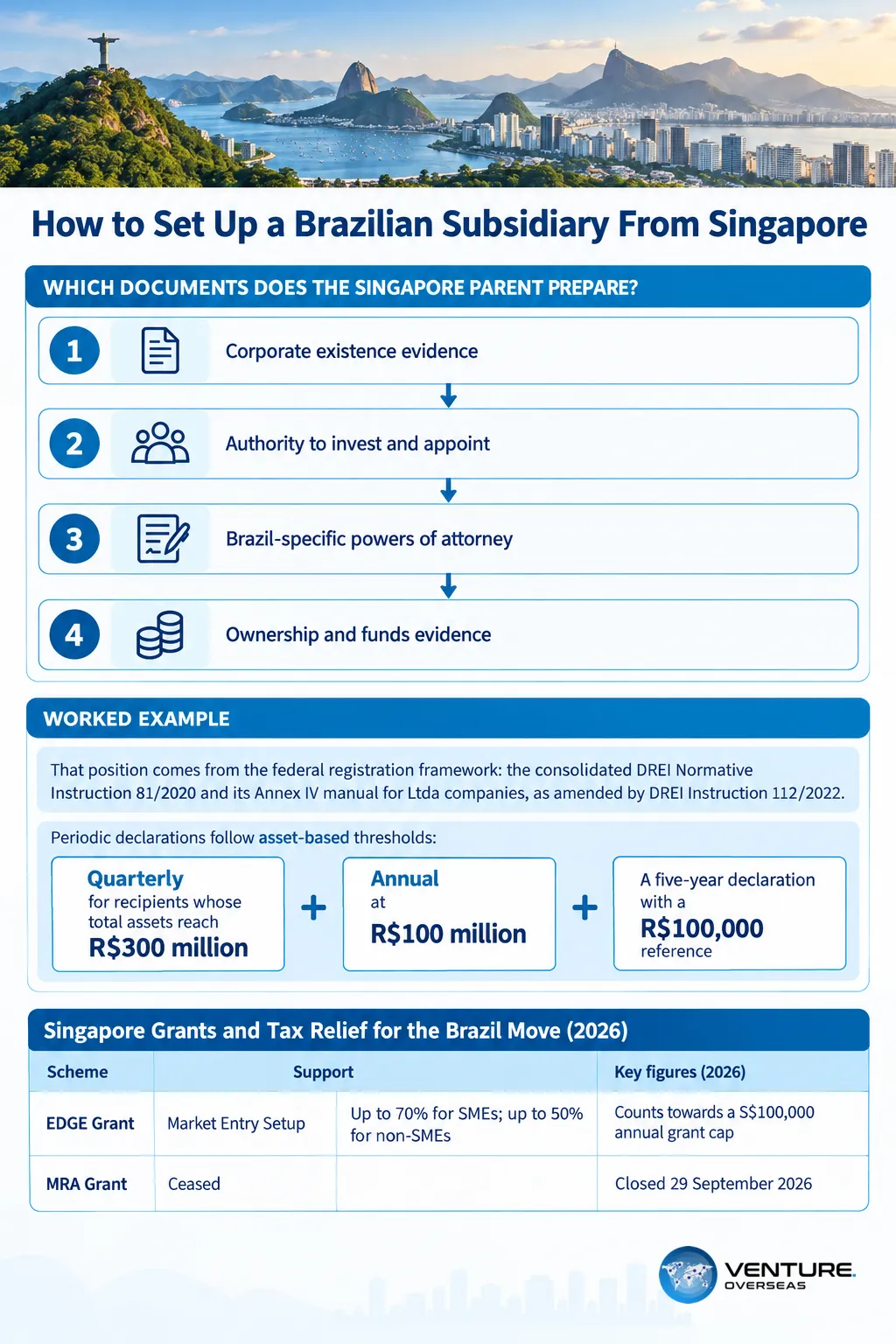
1. Corporate existence evidence
Start with Accounting and Corporate Regulatory Authority (ACRA) evidence of incorporation and current corporate particulars, plus a certified copy of the company constitution. This layer proves the shareholder is real and in good standing.
2. Authority to invest and appoint
A board resolution should approve the Brazilian investment, the capital commitment, the authorised signatory and the representative appointments. Draft it once with the Brazil specifics named, so one document carries the whole authority chain.
3. Brazil-specific powers of attorney
Have Brazilian counsel approve the Portuguese powers before your directors sign in Singapore. The powers must match the administrator and representative mandates exactly; mismatches surface at the registry or the bank.
4. Ownership and funds evidence
Add an ownership chart running to the ultimate beneficial owners, signatory identification, and source-of-funds evidence. Banks usually ask for more than the registry does, and Receita Federal registration has its own needs.
Documents a Singapore Foreign Shareholder Prepares for Brazil
| Document | What it proves | Authentication route |
|---|---|---|
| ACRA incorporation evidence and business profile | The parent exists and its particulars are current | Apostille through SAL where required |
| Company constitution (certified copy) | Governance and signing powers | Apostille through SAL where required |
| Board resolution on the investment | Authority for the entity, capital and appointments | Notarise in Singapore, then apostille where required |
| Brazil-specific power of attorney | Valid appointment of administrator and representatives | Notarise, apostille, sworn translation where required |
| Ownership chart to ultimate beneficial owners | Indirect and ultimate ownership | Notarise, apostille, sworn translation where required |
| Signatory identification and source-of-funds evidence | Identity and origin of funds for bank and tax | Follow the bank's and Receita Federal's checklist |
Where Do You Apostille and Swear-Translate the Documents?
The Singapore Academy of Law (SAL) can apostille verifiable government documents directly; private documents generally need notarisation before SAL authentication. Under the Hague Convention, Brazil accepts an apostille in place of consular legalisation for eligible documents, as the federal business-registry instruction sets out. The receiving authority decides whether legalisation is needed and what it will accept, so verify the route document by document rather than assuming one blanket rule.
For commercial registration, foreign-language documents generally need translation by a Brazilian public sworn translator. Identity documents have an exception in the federal instruction. Confirm with the filing Junta whether each supporting document and its apostille text must be translated. Bank-only documents follow the bank's rules, so we do not translate the whole banking pack unless the institution requires it.
Translation is quoted per page, and a translator's pagination need not match your source PDF. Require a written quote against the scans before authorising the work.
Can a Brazil Ltda Appoint a Non-Resident Administrator?
Yes — a foreign-owned Ltda may appoint an administrator who resides abroad, provided a representative resident in Brazil is appointed with powers to receive service and notices. The representative's mandate must run for at least three years after the administrator's management term ends.
That position comes from the federal registration framework: the consolidated DREI Normative Instruction 81/2020 and its Annex IV manual for Ltda companies, as amended by DREI Instruction 112/2022. The old blanket instruction to appoint a Brazil-resident administrator is outdated. The power of attorney for the appointment must be filed within the registration process or separately, as the manual directs.
Keep the mandates apart in your documents. A foreign corporate shareholder also needs a representative in Brazil, with powers to receive service in proceedings against the shareholder. Receita Federal rules govern the representative handling the shareholder's own tax registration. These are distinct legal capacities. Document the appointments separately and ask counsel whether one person may hold more than one role.
Ask counsel to assess potential liability for each appointment under the applicable corporate and tax rules. Banks may also insist on a Brazil-resident signatory even where corporate law allows a non-resident administrator.
Administrator and Representative Roles in a Brazil Ltda
| Role | Residency | Mandate |
|---|---|---|
| Administrator of the Ltda | May reside abroad | Day-to-day management under the articles |
| Representative for a non-resident administrator | Must reside in Brazil | Receives service and notices for at least three years after the term |
| Representative of the foreign corporate shareholder | Must reside in Brazil | Represents the shareholder, including service in proceedings |
| CNPJ representative for the foreign shareholder | Brazil-based, per Receita Federal rules | Handles the shareholder entity's tax registration |
How Do Registration, the CNPJ and Local Licences Connect?
As one integrated process. The commercial registration and the subsidiary's Cadastro Nacional da Pessoa Jurídica (CNPJ) are processed together through REDESIM. REDESIM is the federal business-registration network. The process is integrated, but commercial registration and CNPJ issuance occur in separate steps; after registration, complete the Receita Federal tax-administration step. Sequence and system steps still vary by state, so do not promise any party simultaneous completion or a fixed processing time.
Once the subsidiary's registration data exist, municipal activation and bank onboarding can run in parallel where the activity allows. A CNPJ alone does not establish that every operating permission has been obtained. Treat licensing as its own stage, and do not trade until the permissions applicable to the actual activity are satisfied.
A low-risk classification can exempt the company from a municipal licence in many municipalities, but the exemption does not remove zoning, safety or other legal obligations. Confirm the current classification and the local conditions before relying on it.
State registration for the goods-circulation tax (ICMS) depends on the activity. One state treasury lists goods circulation and certain transport and communications services among the activities that must register; an ordinary services business should not assume it qualifies. Check the chosen state's rules against your actual CNAE codes.
Capital need not be fully paid before an ordinary Ltda is registered — the articles of association set the subscription and payment terms. Activity-specific rules and exceptions can alter that, so confirm the commitment and any deadline with counsel.
What Must the Subsidiary Sort Out Before It Trades?
Three areas need attention before trading: the tax regime and invoice permissions, any import qualification, and payroll readiness. The exact obligations depend on the municipality, the activity and the hiring plan. Have the Brazilian accountant verify each before the relevant transactions. If hiring, ask the accountant to plan employee onboarding, payroll processing and applicable reporting before staff start.
One rule is settled: a company with a corporate shareholder, or with a shareholder domiciled abroad, is excluded from Simples Nacional, the simplified tax regime. The subsidiary will sit in a regular regime, and the accountant should model which one suits the projected margins and invoicing.
In 2026, Brazil transitions to the new Imposto sobre Bens e Serviços (IBS) and Contribuição sobre Bens e Serviços (CBS). This keeps invoice-system readiness on the launch checklist. The applicable document type and taxpayer status vary, so follow the accountant's reading of current official guidance rather than generic summaries.
If the subsidiary will import, check whether it and its responsible person need Siscomex habilitation; exemptions and product-specific permissions may apply. Available procedures depend on the goods and the transaction, so check both before the first shipment.
Registration and Activation Order for a Brazil Subsidiary
| Stage | Authority or system | Depends on |
|---|---|---|
| Commercial registration | State Junta Comercial | Authority documents, apostilled and sworn-translated where required |
| Subsidiary CNPJ | Receita Federal, via REDESIM | Integrated with the registry filing; sequence varies by state |
| Municipal licence or exemption | The municipality | Registered address and the activity's risk classification |
| State tax registration | The state treasury | Depends on state rules and the activities and operations carried out, including some not subject to ICMS |
| Bank account | The chosen bank | Subsidiary identification and the bank's own pack |
| Capital remittance | Parent, bank and foreign-exchange channel | Bank acceptance and the funding classification |
What Are the Bank Account and Capital Remittance Requirements?
Plan for three layers: a bank pack broader than the registry's, signatory formalities the bank sets itself, and Central Bank reporting on the investment. In our proposed workflow, the account activates once the subsidiary's registration data exist. Capital lands after the bank and its foreign-exchange channel accept the transaction.
That is a proposed dependency order, not a universal banking rule. Confirm account activation, signatory, remittance and foreign-exchange requirements with the intended bank before you schedule the transfer.
Resolve the funding classification before remitting. Whether the money arrives as equity or as a shareholder loan changes the documents, the foreign-exchange processing and the accounting. A mismatch between the contract and the bank record surfaces at reconciliation. Have counsel, the accountant and the bank confirm the treatment — and any separate credit registration — before the transfer.
On reporting, the Banco Central do Brasil operates the SCE-IED system for foreign-direct-investment information, and the reporting obligation rests on the Brazilian recipient. Financial transfers and specified investment movements of at least US$100,000 equivalent can trigger information requirements. Not every transfer requires the same manual filing; check the transaction type, system capture and applicable deadline. An authorised agent may operate the system for you.
Periodic declarations follow asset-based thresholds: quarterly for recipients whose total assets reach R$300 million, annual at R$100 million, and a five-year declaration with a R$100,000 reference. A year covered by the five-year declaration does not also require the annual one; check applicability at each reference date with your reporting agent.
Can Singapore Grants and Tax Relief Support the Brazil Move?
Yes, on both sides of the ledger. Enterprise Singapore's EDGE Grant includes a Market Entry Setup activity that supports overseas entity incorporation, intellectual property registration, tax-structure planning, import and export licensing and agreement drafting. The Double Tax Deduction Scheme for Internationalisation (DTDi) then gives 200% tax deductions on qualifying expenses.
The grant landscape changed in 2026: the MRA, EDG and PSG grants ceased on 29 September 2026, and from 30 September 2026 applications run under the EDGE Grant. For eligible small and medium-sized enterprises (SMEs), Market Entry Setup support reaches up to 70% of qualifying professional-service costs. The support sits within an overall annual grant cap of S$100,000. The project must be completed within 18 months of approval. Non-SMEs can claim up to 50%.
Eligibility mirrors other Enterprise Singapore schemes: the business must be registered and operating in Singapore, with at least 30% of shareholding held by Singaporeans or Singapore permanent residents. Nothing may be started, and no payment or deposit made, before the application is submitted — so file before you commission any Brazil work. Check your position on the BizSG grant recommender.
On the tax side, Budget 2026 raised the automatic DTDi cap from S$150,000 to S$400,000. From Year of Assessment 2027, qualifying expenses within the S$400,000 automatic cap can generally receive the 200% deduction without prior approval, subject to the scheme's conditions and exceptions. Overseas trade offices and e-commerce campaigns still need an application, as do expenses above the cap. The parent must be tax-resident in Singapore or have a permanent establishment there, and meet the scheme's other conditions. Qualifying expenses are computed net of any grant, so the two schemes must be coordinated, not stacked blindly.
We track the moving rules on our grant funding page, because combining an EDGE claim with DTDi deductions is where Singapore parents usually capture the most support.
Singapore Grants and Tax Relief for the Brazil Move (2026)
| Scheme | Support | Key figures (2026) | Notes |
|---|---|---|---|
| EDGE Grant — Market Entry Setup | Up to 70% for SMEs; up to 50% for non-SMEs | Counts towards a S$100,000 annual grant cap | Project completed within 18 months of approval; nothing started or paid before application |
| DTDi (automatic) | 200% tax deduction | Cap raised to S$400,000 of qualifying expenses, from Year of Assessment 2027 | Overseas trade offices and e-commerce campaigns still need approval |
| MRA Grant | Ceased | Closed 29 September 2026 | EDGE Grant replaced it from 30 September 2026 |
What Should You Watch Before Filing in Brazil?
Five factors most often change the recommended order: a regulated activity, a difficult address, a complex ownership chain, a document backlog, and bank signatory rules. We flag them as planning considerations, not as observed delays — their impact depends entirely on the matter.
Before any of this bites, contact Venture Overseas to pressure-test the sequence against your actual activity, state and bank. The cheapest moment to change the plan is before the first document is ordered, not after the first rejection.
1. Regulated activities
Sector permissions can precede or override the standard sequence. If the activity is regulated, map the permissions before the document pack is executed.
2. The registered address
Some municipalities and Juntas scrutinise addresses more closely than others. Premises problems push every later stage, so confirm the address early.
3. Ownership chains
Layered holding structures multiply documents, translations and questions. Flatten what you can, and start the ownership chart at the beginning, not the end.
4. Document backlogs
Where required, notarisation, apostille and sworn translation generally queue in that order. Put the documents on the critical path first. Let the bank checklist and registration inputs move in parallel while translations progress.
5. Bank signatory rules
A bank may require a Brazil-resident signatory regardless of what corporate law allows. Ask before appointing an administrator abroad, not after.
Our proposed sequence starts with the activity, address, ownership, administrator and capital. Authenticate and translate documents where required, then register through REDESIM. Where possible, run licensing and bank onboarding in parallel. Remit and reconcile capital after the bank and foreign-exchange arrangements accept the transaction.
Before execution, put the final checklist in front of four people:
- Your Singapore engagement lead.
- Brazilian corporate counsel.
- The accountant or reporting agent.
- A named bank contact.
Date that review when it actually happens. No reviewer has signed off on a plan that has not yet been checked.
Venture Overseas helps Singapore parents pressure-test that sequence before any document is ordered, from activity codes to the first remittance. If Brazil is on your roadmap, start the conversation early.
Plan the Brazil Filing Before You Sign
Bring your activity codes, target state and timeline. We map the document pack, apostille route, registration sequence and bank requirements before anything is executed.
Frequently Asked Questions
Yes, provided a representative resident in Brazil is appointed to receive service and notices, with the mandate running for at least three years after the administrator's term. The power of attorney is filed with the registration or separately, and banks may still require local signatories.
The foreign corporate shareholder may need its own CNPJ, separate from the subsidiary's. Ask the Brazilian accountant to confirm the obligation and current filing route for the shareholder and investment.
Singapore and Brazil are both Hague Convention parties, so eligible Singapore documents can be apostilled by the Singapore Academy of Law where required, and Brazil dispenses with consular legalisation for apostilled documents. Private documents are notarised before the apostille, and the receiving Junta determines what it accepts.
No. For an ordinary Ltda, the articles of association set when capital is subscribed and paid, so payment can follow registration. Activity-specific rules can differ, so confirm the commitment and deadline with counsel.
Yes. Since 30 September 2026 the EDGE Grant has replaced the MRA, and its Market Entry Setup activity supports up to 70% of qualifying costs for SMEs within a S$100,000 annual grant cap. DTDi adds a 200% deduction on up to S$400,000 of qualifying expenses from Year of Assessment 2027. Nothing may be started or paid before the grant application is submitted.

Venture Overseas
Global business expansion guides
Venture Overseas is a Singapore-headquartered company that helps entrepreneurs and businesses expand overseas with market information, country guides and information on grants and funding.