For international expansion, should your SME choose licensing, franchising, a joint venture or a wholly owned subsidiary? The decision shapes who funds the market, owns customer relationships and bears the cost if plans change.
Plenty of guides present the four options as a simple ladder, from a cheap licence at the bottom to an expensive subsidiary at the top. Our team's view is that the ladder oversimplifies. A franchise can conserve your capital while keeping your brand fully exposed; a joint venture can share control yet still demand serious funding.
The right mode depends on verified demand and the capital you can afford to lose. It also depends on the manager who will run the market and the controls you refuse to delegate. It also depends on the destination's own rules — Australia, for instance, can treat a 'licence' as a franchise regardless of what the parties call it.
In this blog, we compare overseas market entry strategies for Singapore SMEs. We cover screening questions, the four options, an illustrative services SME, Australian rules, grants and tax relief.
Table of Contents
Which Screening Questions Come Before Choosing an International Market Entry Mode?
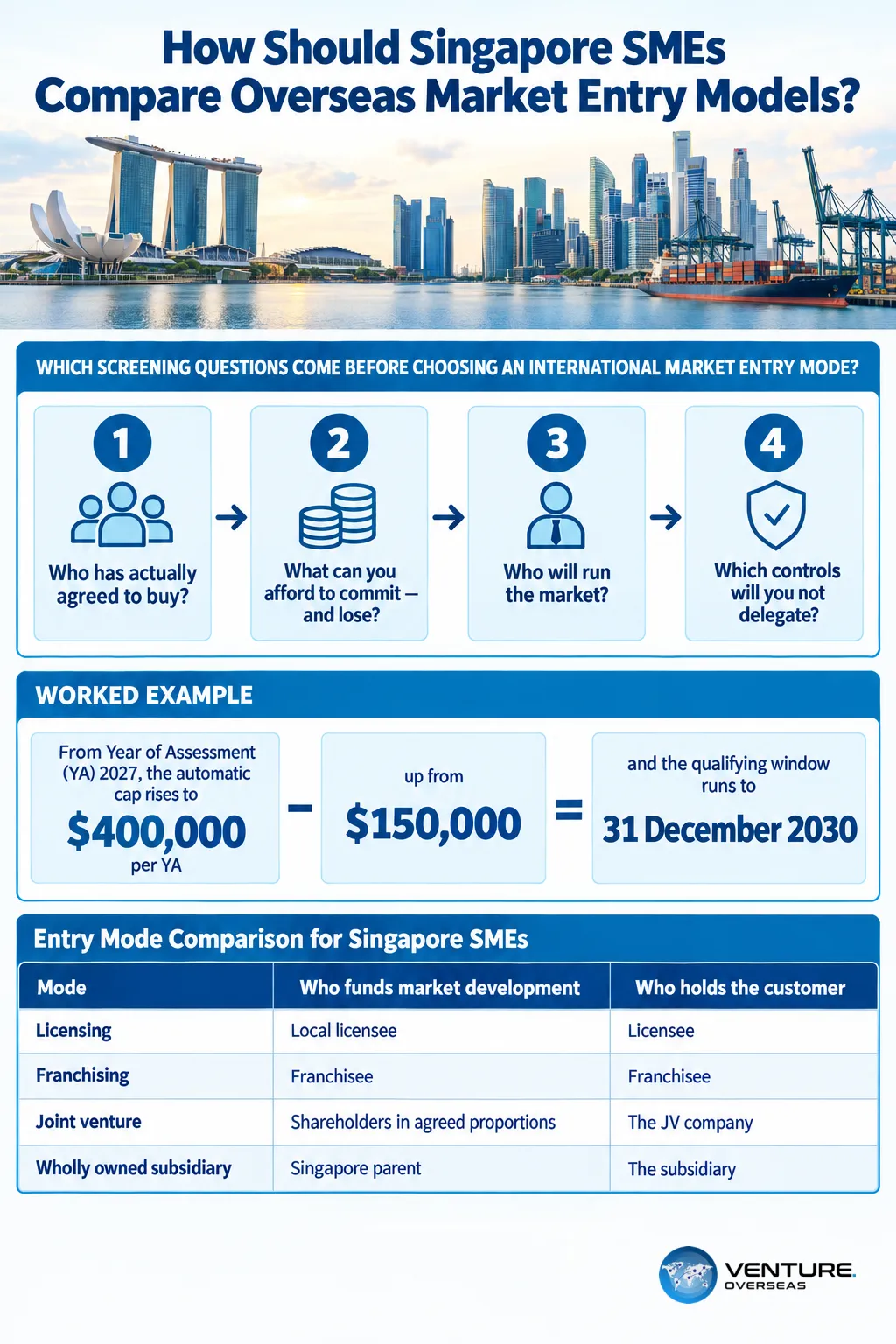
Before comparing structures, we ask four questions — and the answers usually point to one or two modes before any model is on the table. This sequence is our team's working framework rather than a formula. It is professional judgement about what usually decides the question, so test it against your own facts.
If you are still early in taking your business global, these questions come before any talk of structures or destinations.
1. Who has actually agreed to buy?
Interest is not demand. Look for named prospects who will sign with your chosen vehicle, in the target market, at your prices. Without that, no entry mode fixes the underlying problem.
2. What can you afford to commit — and lose?
Establish the cash the business can lose without hurting Singapore operations. Limited capital and no overseas operating team push toward licensing or franchising, but only if the business can genuinely support a partner.
3. Who will run the market?
A named manager, not good intentions. Committed capital plus a credible local manager makes a subsidiary realistic; a genuinely complementary partner makes a joint venture worth examining.
4. Which controls will you not delegate?
Some owners cannot tolerate another operator holding the customer relationship. If quality depends on daily supervision and close customer knowledge, direct ownership earns a closer look.
When Does Each Overseas Market Entry Model Fit Best?
Each of the four overseas expansion options earns consideration under different conditions. The mode should follow the rights you grant and the commitment you can sustain — not the size of the entry cheque. The comparison table illustrates possible allocations; actual funding, customer relationships and exit costs depend on the agreements.
1. Licensing: a separable asset
Licensing merits consideration when your SME holds something a local operator can use independently — software, a protected process or a brand standard. In one possible arrangement, the licensee funds delivery and customer acquisition, holds customer contracts and controls daily execution. You keep the oversight, reporting and audit rights you negotiate.
2. Franchising: a teachable format
Franchising fits when a documented, teachable business format can be operated by someone else with viable unit economics. In one possible arrangement, the franchisee funds the local business and employs the delivery team. You prescribe the format and monitor contractual standards. Not every operating business is ready to franchise, and a format alone will not rescue an immature model.
3. Joint venture: a capability you cannot simply buy
A joint venture earns consideration only when a partner brings a material capability — customer access, facilities, operating know-how — that is difficult to purchase separately. A simple introduction to the country rarely justifies permanent shared ownership and years of negotiated governance.
4. Wholly owned subsidiary: control that earns its cost
A subsidiary fits when direct operational control justifies the capital and management commitment. In one possible structure, the Singapore parent funds the venture and steers it through its board. The local company signs the customer contracts. Ownership does not guarantee demand or performance, so the case must stand on its own merits.
Entry Mode Comparison for Singapore SMEs
| Mode | Who funds market development | Who holds the customer relationship | Who bears the cost of changing course |
|---|---|---|---|
| Licensing | Local licensee | Licensee | Both parties: contractual exit and brand-recovery costs |
| Franchising | Franchisee | Franchisee | Franchisor: termination, transition and reputational costs |
| Joint venture | Shareholders in agreed proportions | The JV company | Shareholders: valuation and negotiation risk |
| Wholly owned subsidiary | Singapore parent | The subsidiary | Parent: full funding of any restructuring |
How Would an Illustrative Services SME Compare Across the Four Modes?
To make the comparison concrete, consider an illustrative scenario. It is a proposed hypothetical, not a client case, completed engagement or observed result.
Picture a Singapore commercial-cleaning SME selling recurring contracts to offices and light-industrial premises, weighing Brisbane to follow regional customers. Assume the owner can commit a defined budget over a fixed funding window and release an experienced manager for set-up. The owner also wants direct responsibility for service standards and customer renewals. Its advantage is operating discipline, training and account management — not patented equipment.
Licensing is ruled out first, because the value lies in coordinated service delivery rather than an independently valuable piece of intellectual property. A light-touch licence would leave too much execution risk with the operator. A heavily controlled licence raises the question of whether the arrangement is legally a franchise in Australia.
A joint venture is ruled out because the assumed local contact offers introductions rather than a scarce operating asset. The SME could purchase that service instead of permanently sharing ownership. Franchising is the runner-up: cleaning can be systemised, and a franchisee could fund equipment, recruitment and working capital.
The subsidiary is the initial choice because the owner wants the Australian entity to contract directly with customers. The owner also wants to retain account information and control staffing and corrective action. The tipping points are the available operations manager, the committed capital and customers willing to consider the local entity. Remove any one of those three and ownership stops being the obvious answer.
The same gates apply whatever the destination. For a regional hub, see our guide on why start a business in Hong Kong. Further afield, our article on why start a business in Mauritius covers an Indian Ocean base.
Screening the Illustrative Cleaning SME Against Each Mode
| Mode | Verdict in the illustration | Main reason |
|---|---|---|
| Licensing | Ruled out | Value lies in coordinated delivery, not separable IP |
| Franchising | Runner-up | The service can be systemised and a franchisee could fund set-up |
| Joint venture | Ruled out | Introductions can be purchased; no scarce operating asset |
| Wholly owned subsidiary | Initial choice | Available manager, committed capital and willing customers all line up |
What Australian Compliance Rules Shape the Entry-Mode Choice?
Australia shows how a destination's law can push an SME away from its preferred structure. Treat the points below as matters to raise with local advisers, not as legal conclusions for your transaction.
The Australian Competition and Consumer Commission (ACCC) administers the Franchising Code. An agreement can be a franchise regardless of its label; classification depends on its features and applicable exceptions. Franchisors generally must give prospective franchisees a disclosure document at least 14 days before signing. Limited opt-outs apply. New franchisors must join the disclosure register at least 14 days before entering an agreement. They must also join before selling or transferring one. Confirm which requirements apply with Australian counsel.
The Fair Work Ombudsman has also published guidance under which certain franchisors can be held responsible for franchisees' workplace-law contraventions. Liability is conditional, but the exposure is real and should shape how much supervision your format prescribes.
For a subsidiary, the Australian Securities and Investments Commission (ASIC) requires a proprietary company to have at least one director who normally lives in Australia. Depending on the investor and the transaction, Treasury's foreign-investment rules can require notification or approval, so never assume an exemption applies.
On the tax side, the Australian Taxation Office (ATO) notes that royalty payments to foreign residents can attract withholding tax. Treaty rules and a permanent-establishment exception may also be relevant. Related-party dealings — a parent loan or management fees — must be priced on arm's-length terms or face transfer-pricing consequences. Australian Goods and Services Tax (GST) registration may also be required once the applicable turnover threshold is met or expected. Each of these points needs transaction-specific advice.
Australian Compliance Checks by Entry Mode
| Mode | Key compliance considerations |
|---|---|
| Licensing | ATO withholding tax on royalties paid to foreign residents; treaty rules may apply |
| Franchising | ACCC disclosure-document and register obligations; possible franchisor liability for franchisee workplace breaches |
| Joint venture | Resident-director requirement; foreign-investment notification may apply; governance set by the shareholders' agreement |
| Wholly owned subsidiary | Resident-director requirement; foreign-investment notification; GST registration; arm's-length pricing of related-party dealings |
How Can You Fund the Move and Test It Before Committing?
Before signing anything, we work through a set of stop/go gates with the business owner. This is our team's working checklist — reasoned judgement, not an industry benchmark — and it deliberately compares entry against delay or smaller-scale validation.
On funding, Singapore launched the EDGE Grant on 30 September 2026. It replaced new applications under MRA, EDG and PSG; eligible activities share a company-wide annual cap. We cover the details in our guide to how Singapore SMEs tap overseas expansion grants under the EDGE scheme.
Tax relief can also reduce the cost of market development. Under the Inland Revenue Authority of Singapore (IRAS), the Double Tax Deduction for Internationalisation (DTDi) scheme gives a 200 per cent deduction on qualifying expenses. From Year of Assessment (YA) 2027, the automatic cap rises to $400,000 per YA — up from $150,000 — and the qualifying window runs to 31 December 2030. From YA 2027, the automatic list also adds master licensing and franchising, market surveys and feasibility studies, overseas business development and investment feasibility studies. Prior approval from Enterprise Singapore or the Singapore Tourism Board is still needed for overseas trade offices, e-commerce campaigns and expenses above the cap.
Stop/go gates we test include:
- Unit economics: will the local operation pay its own way at realistic volumes?
- Legal feasibility: does the chosen mode actually work under the destination's rules?
- Partner diligence: has the partner's or franchisee's track record been verified?
- Operating documentation: could someone else run the model from your manuals?
- Cash runway: can the group survive the slowest realistic ramp-up?
The four overseas expansion options each solve a different problem. Licensing monetises a separable asset, and franchising replicates a teachable format. A joint venture secures a capability you cannot easily buy, while a subsidiary buys control at full cost. Your screening answers — demand, capital, management capacity and non-negotiable controls — should pick the mode before any structure is drawn up.
In the illustration, a subsidiary is the initial choice because the assumed manager, capital and customer readiness line up. A different business entering the same market could sensibly choose another mode. That is why the comparison must be run on your own facts, with the destination's compliance rules checked early rather than late.
Venture Overseas helps Singapore SMEs run exactly this comparison — from screening questions to partner diligence, funding and grant support — before any commitment is made. Talk to us about planning your next market with a mode that fits the business you actually have.
Plan Your Expansion with the Right Entry Mode
Tell us your target market and we will help you weigh licensing, franchising, a joint venture or a subsidiary against your capital, capacity and must-keep controls.
Frequently Asked Questions
No. Ownership gives the clearest decision authority, but it does not guarantee demand, performance or freedom from risk. In the illustration, a subsidiary is the initial choice because a manager, committed capital and willing customers are assumed. If those conditions change, reassess the alternatives.
Licensing grants rights to use a separable asset, such as software or a protected process, without necessarily transferring ownership. Franchising transfers a whole documented business format the recipient must follow. In Australia, the ACCC can treat an arrangement as a franchise based on its features, even if the parties call it a licence.
Yes. Under IRAS rules, the DTDi scheme offers a 200 per cent deduction on qualifying expenses, with the automatic cap rising to $400,000 per Year of Assessment from YA 2027 and the scheme running to 31 December 2030.
Yes. ASIC requires an Australian proprietary company to have at least one director who normally lives in Australia, so director eligibility should be confirmed before incorporating.
Delay is a legitimate choice. Compare each mode against waiting, or validating the market at smaller scale through trade fairs or business matching, then re-run the comparison once demand, capital or management capacity improves.

Venture Overseas
Global business expansion guides
Venture Overseas is a Singapore-headquartered company that helps entrepreneurs and businesses expand overseas with market information, country guides and information on grants and funding.